
Personally, I can’t think of a better way to welcome friends over on a cozy Sunday evening than with the smell of freshly baked bread wafting through the rooms. Inspired by my deep love for matzoh ball soup, and a new weekly Sunday night friends dinner tradition at our home, I decided to go all out with all the tastiest (and good for the soul – and waist line) traditional dishes: Challah bread, kugel, and matzoh ball soup. Our friends, Liz and Sterling, were generous enough to make the soup, while I focused on the good ole’ carb dishes. Here I’ll share for you my very first adventure in the makings of challah bread!
Ingredients
- 8 cups all-purpose flour (I recommend specifically, “bread” flour)
- 1/2 cup sugar (plain, granulated sugar)
- 3 1/3 tablespoon melted butter
- 2 eggs
- 2 cups warm water
- 4.2 teaspoons dry, active yeast
- 3 teaspoons salt
- 1 egg (for brushing)
- white sesame seeds (for end)
Disclaimer about measurements!
This is an authentic, Israeli recipe with only foreign-to-American terms like “kilograms,” “milliliter,” “gram,” etc. It took some extra leg-work (more like brain-work) to convert these to US-measurements. That’s why some of the measurements are at odd intervals above. Here’s a photo of the conversions.
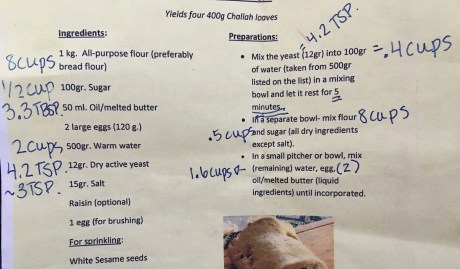
Shopping List
- Flour. As I mentioned, I recommend the specific “bread flour.” You can find it in the general flour section). I like King Arthur Unbleached Bread Flour.
- Sugar. You likely already have regular Domino Premium Pure Cane Granulated in your cabinet.
- Butter. As a rule of thumb, always defer to un-salted butter when baking. You always end up adding salt as its own ingredient anyway.
- Yeast. The most traditional and easy to find kind is Fleishmann’s Active Dry Yeast (Original). Looks like something from your grandmother’s kitchen. You’re going to need at least 2 of these 50 cent packets.
- Salt. Regular table salt is fine.
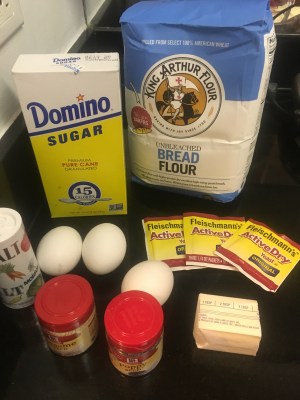
Recipe: 3 phases = 1. Preparation, 2. Procedure, 3. Baking
Preparation:
First, mix the yeast (4.2 teaspoons) into .4 cups of warm water. This .4 cups of water is subtracted from the 2 cups of water the recipe calls for. Remember, warm water. Stir the yeast for about 15 seconds until integrated in the water and let rest for 5 minutes.
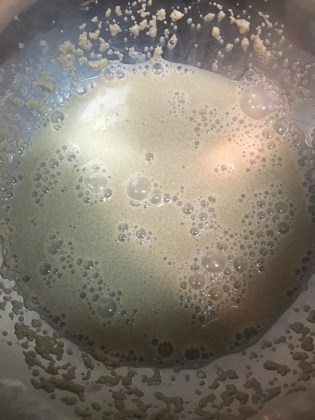
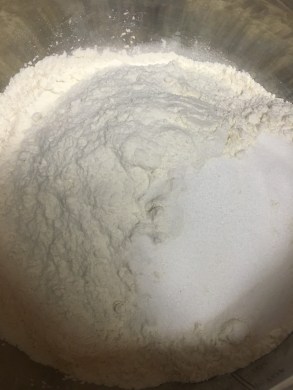
While the yeast is doing it’s thing (kind of creepy, did you know yeast is alive?) mix 8 cups of flour and the 1/2 cup sugar in a separate bowl. This is the dry ingredient preparation step (minus salt).
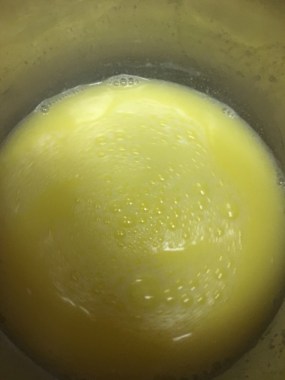
Also, while the yeast is resting, in another bowl, mix the remaining water (1.6 cups), 2 eggs, melted butter until incorporated. This is the liquid ingredient preparation step.
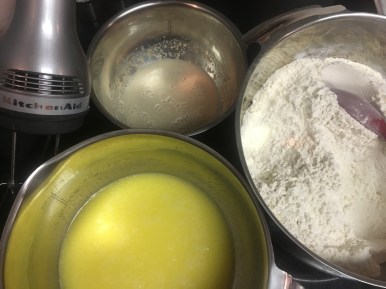
At this point, you will now have 3 things prepared – the yeast, the dry ingredients, the wet ingredients. Here’s what the spread should look like. The prep work is done!
Procedure:
First, transfer the dry ingredients to a mixing bowl and start mixing in slow speed. This is #2 speed level on the electric mixer. NOTE: I tried to use the regular Kitchen Aid hand mixer we have, but to no avail. The dough becomes too thick and you truly need a real bread mixer. So, unless you have a bread mixer, do NOT even try to use your hand mixer. Instead, do what I did (trust me, it comes out well!) and use your hands. The best kitchen tool!
You’re going to add the liquid ingredients and mix the dry and wet together for about 2 minutes. If using a real bread mixer, after 2 minutes, put the level to #6 speed level. As you’re mixing, slowly add the salt, pinch by pinch, Continue mixing until the dough reaches smooth consistency. All in, should take you about 5 minutes.
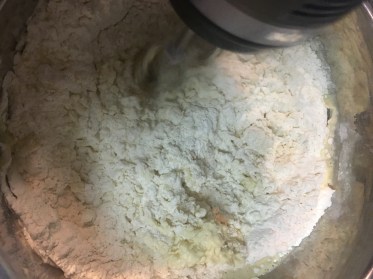
After you create a real dough, knead the dough to a ball form (best strategy is to just take the dough out of the bowl to do this) and then return it to the mixing bowl.
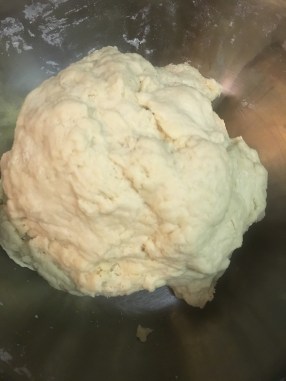
Cover the bowl with either a wet towel – or – saran wrap with a small hole. I prefer the wet towel method (just run a paper towel quickly under water). Let the dough rise for 60 minutes in room temperature. After 60 minutes, take a peak and as long as the dough has about doubled in size, it’s time for the next step!
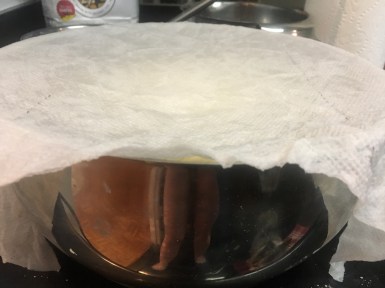
Next, remove the dough from the bowl and separate into 4 equal sized portions. Each of these will be its own loaf. I recommend using a knife and cutting the ball into quarters (like you would split an apple into 4 pieces – lengthwise and vertically). Now, braid each piece. How? Easy! Divide each of the 4 pieces into 3 equal-sized parts and roll out each with your hand to approximately 15 inches. On a cutting board, put the now 3 rolled out parts vertically and an inch apart from each other. Starting at the top, pinch the 3 together to start the braid, and braid from that point down (towards you). You should have about 4 total cris-crosses per loaf.

Do this for each of the 4 loaves and place the braided dough on an un-greased, no stick baking sheet. You’re going to practice patience again here by letting the braided dough rise for 40 minutes. (This blog isn’t called “patience in the kitchen” for no reason!)
Baking:
While the 4 loaves are hanging out on the baking sheet and rising for these 40 minutes, pre-heat your oven to 400 degrees.
Also while the loaves are rising, you’re going to scramble one egg which will be the “paint” to brush the dough. After 40 minutes, take a baking brush, and simply brush the egg wash over each loaf. This is a very important step and gives your bread that beautiful golden shine/glow. Then, sprinkle with sesame seeds.
Bake the dough at 400 degrees for 10 minutes. Then, lower the temperature to 350 and bake for 10-15 minutes. You’re going to want to tap the bread lightly and if it bounces back, it’s ready. You can also gauge based on the color. The bread should be golden/brown.
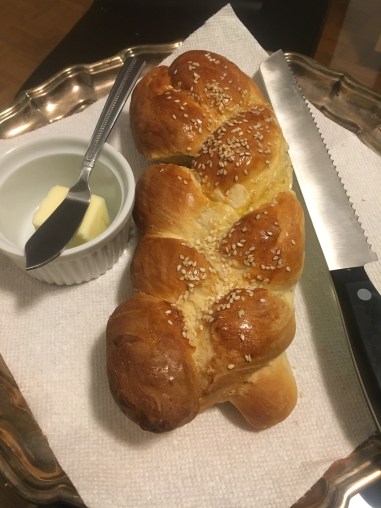
Place the loaves on a rack to cool (about 30 minutes). By now, your kitchen and surrounding rooms will smell inviting and anyone (or dog) within nose reach will be flocking to the dining table to grab a slice – or loaf!








 Lizzie's Cooking Blog